If you or someone you care for has been working through a swallowing disorder, you may have heard the term sEMG biofeedback come up in conversation. It sounds technical, and it is - but the idea behind it is pretty intuitive: we learn faster when we can see what's happening in our bodies in real time.
Swallowing therapy has traditionally relied on a therapist watching and guiding, while the patient works largely on feel alone. That works, but it has limits. The muscles involved in swallowing are deep, fast-moving, and mostly invisible to the naked eye. sEMG biofeedback changes that equation by giving both the therapist and the patient a live window into what those muscles are actually doing - and that information can make a meaningful difference in how quickly and completely someone recovers.
This post breaks down what sEMG biofeedback is, how it works in a clinical setting, the conditions it's best suited for, and what to realistically expect from treatment.
- What Is sEMG Biofeedback?
- How It Works During a Swallowing Session
- Why Real-Time Feedback Matters for Swallowing Rehab
- Who Benefits Most from sEMG Biofeedback?
- Conditions Commonly Treated with sEMG
- How sEMG Fits With Other Diagnostic Tools
- What to Expect in an sEMG Biofeedback Session
- How Long Until You See Results?
- Frequently Asked Questions
What Is sEMG Biofeedback?
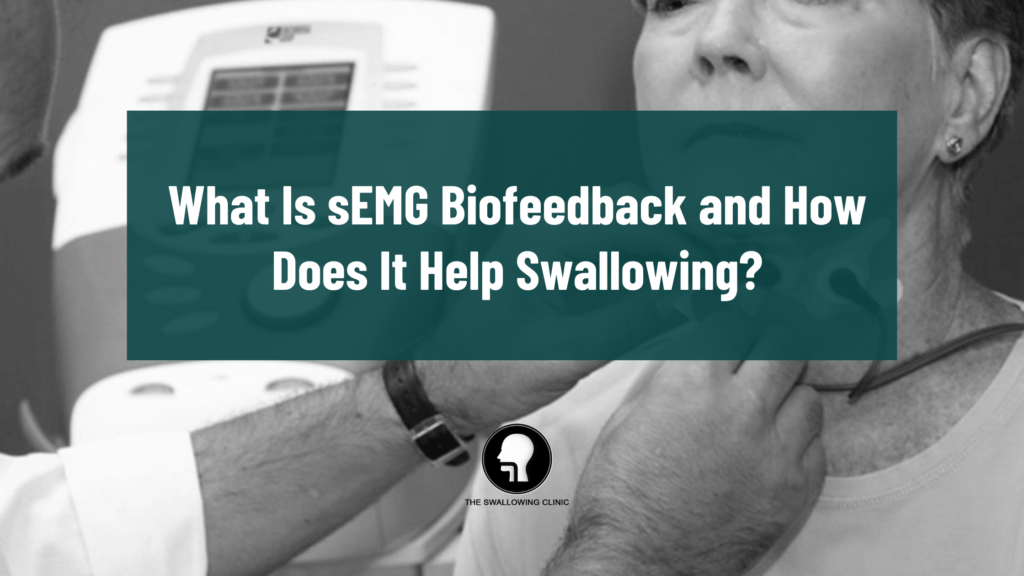
sEMG stands for surface electromyography. It's a technology that measures electrical activity in muscles by picking up signals through sensors placed on the skin. You may have seen similar technology used in physical therapy or athletic training. In swallowing rehabilitation, the sensors are placed on the neck, just beneath the chin, over the muscles that are most active when you swallow.
When muscles contract, they generate tiny electrical signals. sEMG equipment captures those signals and translates them into a visual display - often a moving waveform or bar graph - that updates in real time. The therapist and patient can see the timing, intensity, and pattern of muscle activity as each swallow happens.
The biofeedback part refers to using that data as a feedback loop. Instead of guessing whether a muscle is firing correctly, you can see it. That visibility changes what you can do in therapy - both in terms of what the clinician learns and how quickly the patient can make adjustments.
How It Works During a Swallowing Session
Setting up sEMG for a swallowing session is a straightforward process. Small surface electrodes - usually self-adhesive and no bigger than a small bandage - are placed on the skin over the submental muscle group (the muscles under the chin and along the throat that drive the swallowing sequence). No needles, no pain, nothing invasive.
-
Electrode Placement
The clinician positions the sensors on the skin surface over the target muscles. Placement is precise - small shifts in electrode position can change the quality of the signal captured.
-
Baseline Reading
Before any exercises begin, the therapist establishes a baseline - measuring the muscle activity at rest and during a resting swallow to understand the patient's current pattern.
-
Visual Feedback Display
A monitor displays the muscle signal in real time. Many clinicians orient the screen so the patient can watch their own swallowing pattern as they work through exercises.
-
Guided Exercise
The therapist guides the patient through targeted movements - effort swallows, tongue holds, head raises, or other exercises specific to the patient's deficit profile. The display helps both parties see what's working.
-
Adjustment and Reinforcement
When the patient achieves the target pattern, they see it on the screen. That visual confirmation accelerates motor learning - the brain gets a clear signal that the pattern was correct, making it easier to reproduce.
Sessions typically run 45 to 60 minutes and are conducted by a speech-language pathologist (SLP) trained in the use of sEMG equipment. The frequency of sessions depends on the severity of the swallowing impairment and the patient's broader treatment plan.
Why Real-Time Feedback Matters for Swallowing Rehab
Swallowing is one of the most complex motor tasks the human body performs. It involves more than 30 muscles and six cranial nerves, all coordinating in a sequence that takes less than a second from start to finish. Most of that happens automatically, below conscious awareness.
When swallowing breaks down - due to stroke, neurological disease, head and neck cancer treatment, or other causes - relearning the correct muscle patterns is the core challenge of rehabilitation. The problem is that the muscles involved are largely out of reach. You can't observe them directly. You can't feel individual muscle activation the way you might feel your arm muscles during a bicep curl.
That's where biofeedback has a structural advantage. Research in motor learning consistently shows that external feedback accelerates skill acquisition. When learners can see or hear the result of their movement in real time, they build accurate internal models of the task faster. sEMG biofeedback applies this principle to swallowing therapy, giving patients the external signal their nervous systems can use to recalibrate.
This feedback loop is particularly valuable when patients have reduced sensation in the throat or when the deficit involves subtle timing problems rather than a complete failure of muscle activation. A therapist can see from the sEMG waveform whether a muscle is firing at the right moment, with sufficient intensity, and for the correct duration - details that are impossible to assess through observation alone.
Who Benefits Most from sEMG Biofeedback?
sEMG biofeedback isn't a one-size-fits-all tool, and good clinicians are selective about when and how to use it. It tends to deliver the most benefit to patients who meet a few key criteria.
Neurological Conditions
Stroke survivors and patients with Parkinson's disease, MS, or ALS who have muscle weakness or incoordination affecting the swallow sequence.
Post-Cancer Treatment
Patients recovering from head and neck cancer radiation or surgery who have structural or neuromuscular changes to the throat or larynx.
Motivated and Engaged
Patients who are cognitively intact and motivated to participate actively - biofeedback is a participatory therapy, and engagement drives results.
Plateau in Traditional Therapy
Patients who have made progress with conventional swallowing exercises but have reached a ceiling that added feedback may help break through.
Subtle or Complex Deficits
Cases where the timing or pattern of muscle activation is disordered in ways that aren't visible from outside - sEMG captures what observation misses.
Home Practice Support
Patients doing intensive home exercise programs who benefit from objective markers to track their own progress between clinic sessions.
Patients with significant cognitive impairment, very poor attention, or conditions that produce highly erratic baseline muscle signals may be less suited to sEMG-guided therapy. A thorough evaluation helps the clinician determine whether this tool is a good fit before incorporating it into the treatment plan.
Conditions Commonly Treated with sEMG Biofeedback
At The Swallowing Clinic, sEMG biofeedback is used as part of comprehensive dysphagia treatment for patients across a range of diagnoses. The following conditions are among those where this approach is most frequently applied.
Dysphagia Following Stroke
Stroke is one of the leading causes of dysphagia in adults. Depending on the location and extent of the stroke, swallowing deficits can range from mild slowing of the swallow reflex to significant aspiration risk. sEMG biofeedback is well-supported in post-stroke dysphagia rehabilitation, particularly for patients who retain some degree of muscle activation but need help restoring normal timing and coordination.
Dysphagia in Parkinson's Disease
Parkinson's affects swallowing through several mechanisms: reduced muscle force, slowed movement, and diminished sensory awareness that reduces the patient's ability to feel what's happening during a swallow. sEMG helps by providing the external feedback the patient's own sensory system isn't reliably supplying. It pairs well with LSVT (Lee Silverman Voice Treatment) and other effort-based approaches commonly used in this population.
Post-Treatment Dysphagia in Head and Neck Cancer
Radiation therapy to the head and neck can cause fibrosis - a stiffening and scarring of the soft tissues of the throat - that significantly impairs swallowing. Surgery in this region may remove or alter structures involved in the swallow sequence. sEMG biofeedback supports the intensive muscle work needed to maintain and regain function in these patients, often in combination with other interventions like NMES (neuromuscular electrical stimulation) or manual therapy.
Neurogenic Dysphagia
For patients with ALS, multiple sclerosis, or other progressive neurological conditions, the goals of swallowing therapy shift over the course of the disease. Early in the disease process, sEMG-guided exercise may help patients maintain strength and coordination for longer. As the condition progresses, the focus typically moves toward compensatory strategies and diet modifications. Monitoring through sEMG can also help the clinical team track changes over time.
Idiopathic or Functional Dysphagia
Some patients experience difficulty swallowing without a clear structural or neurological cause. These cases can be particularly challenging because the deficit isn't visible in imaging and doesn't have an obvious mechanism. sEMG can sometimes reveal patterns of muscle tension, incoordination, or avoidance behavior that aren't detectable through standard evaluation, providing a starting point for targeted treatment.
How sEMG Fits With Other Diagnostic Tools
sEMG biofeedback is a treatment tool, not a diagnostic imaging test. It doesn't show you the anatomy of the throat or reveal whether material is being aspirated. For that, you need instrumental assessment. Understanding how sEMG relates to the other tools used in dysphagia care helps clarify what it can and can't do.
| Tool | What It Shows | Role in Care |
|---|---|---|
| Modified Barium Swallow (MBS) | X-ray video of swallow mechanics and airway protection | Diagnosis, aspiration detection |
| Fiberoptic Endoscopic Evaluation (FEES) | Direct endoscopic view of pharynx and larynx | Diagnosis, residue and aspiration visualization |
| sEMG Biofeedback | Real-time surface muscle electrical activity | Treatment, motor learning, progress monitoring |
| Manometry | Pressure measurements within the esophagus and pharynx | Diagnosis, esophageal function assessment |
In practice, a complete dysphagia workup often starts with one of the instrumental assessments (typically MBS or FEES) to establish what's going wrong structurally and functionally. sEMG biofeedback then becomes part of the treatment program, helping the patient work toward the targets identified in that assessment.
What to Expect in an sEMG Biofeedback Session
If you've been referred for swallowing therapy that includes sEMG biofeedback, or if you're curious what those sessions actually look like, here's a practical walkthrough.
Before You Arrive
No special preparation is required for sEMG biofeedback. You don't need to fast. You'll want to wear comfortable clothing with easy access to your neckline, since sensors are placed along the jawline and neck. If you have a skin allergy to adhesives, let the clinic know in advance.
During the Session
Your clinician will explain what the sensors are measuring and what you'll see on the screen. After placement, you'll have a few moments to get familiar with how the display responds to your movements. Many patients find this part interesting - seeing your own muscles "speak" in real time has a way of making the whole thing feel less abstract.
The exercises themselves vary based on your specific deficit. Common approaches include effort-based swallowing exercises like the Mendelsohn Maneuver or effortful swallow, where the goal is to produce a stronger or more coordinated muscle response than your baseline. The sEMG display lets you and your therapist see whether you're reaching the target and adjust the approach accordingly.
After the Session
Your therapist will review what the session showed and explain how it fits into your overall progress. Many patients are given home exercises to practice between sessions. Your clinician may share printouts or a summary of your session data to help track changes over time.
Most people don't find sEMG biofeedback sessions difficult or tiring beyond normal therapy fatigue. The sensors are non-invasive and the setup and takedown are quick.
How Long Until You See Results?
This is the question everyone reasonably wants answered, and the honest answer is: it depends. The timeline for improvement in swallowing therapy is shaped by several factors, and sEMG biofeedback doesn't change the underlying biology - it makes the existing therapy process more efficient.
What the research suggests, broadly, is that biofeedback-augmented therapy tends to produce faster and more sustained improvements than exercise alone in motivated, cognitively intact patients. Studies in post-stroke dysphagia have shown meaningful improvements in swallowing function and aspiration rates over courses of 4 to 12 weeks of intensive therapy, with sEMG biofeedback patients often reaching targets faster than those working without feedback.
Key factors that influence the timeline include:
- The underlying cause and severity of the swallowing impairment
- How much time has passed since the initial injury or onset
- The patient's consistency with home exercise programs between sessions
- The presence of other medical conditions affecting healing or participation
- Cognitive function and the ability to actively engage with the feedback process
Your clinician will set realistic, individualized goals based on your evaluation results and revisit those goals regularly as therapy progresses. Progress in swallowing therapy isn't always linear - there are often periods of faster improvement followed by slower consolidation phases. Consistent participation is one of the strongest predictors of a good outcome.
Frequently Asked Questions
Have questions about whether sEMG biofeedback is right for you or someone you care for? Our team is happy to talk through your situation. Contact The Swallowing Clinic to schedule a consultation or ask us anything before you book.
Is sEMG biofeedback painful or uncomfortable?
No. The surface electrodes are adhesive sensors placed on the skin - there's nothing inserted, nothing that produces electrical stimulation, and nothing that causes pain. Some patients feel a mild skin sensation from the adhesive, but the procedure itself is non-invasive and well-tolerated. It's different from NMES (neuromuscular electrical stimulation), which does deliver a small electrical current - sEMG only records muscle activity, it doesn't stimulate it.
Is sEMG biofeedback the same as VitalStim?
No. VitalStim is a brand name for neuromuscular electrical stimulation (NMES), which delivers small electrical currents to stimulate muscle contraction. sEMG is a passive recording technology - it measures what your muscles are doing without adding any external stimulus. The two are sometimes used together as part of a comprehensive treatment program, but they're distinct tools with different mechanisms.
Does insurance cover sEMG biofeedback for swallowing?
Coverage varies by payer, plan, and the specific billing codes used. sEMG biofeedback for dysphagia is covered by many insurance plans when it's medically necessary and provided as part of a comprehensive speech therapy program. Your care team can help verify your specific benefits. If you're unsure about coverage, our staff can walk you through what to ask your insurer.
Can sEMG biofeedback be used at home?
Some portable sEMG devices exist, and there's growing interest in telehealth-supported biofeedback for patients who can't attend in-person sessions regularly. In practice, the most effective use of sEMG biofeedback is in a clinical setting with a trained therapist interpreting the data in real time. Home exercise programs are typically built around exercises learned during clinic sessions, without the device itself.
How is sEMG biofeedback different from regular swallowing therapy?
Conventional swallowing therapy uses the therapist's observation, patient self-report, and clinical judgment to guide exercise and measure progress. sEMG biofeedback adds an objective, real-time data layer. This doesn't make conventional therapy obsolete - the therapist's expertise remains essential - but it gives both the therapist and patient more information to work with. Think of it as an additional tool in the clinical toolbox rather than a replacement for skilled care.
Who decides whether I need sEMG biofeedback?
Your speech-language pathologist makes that determination based on your evaluation results, goals, and response to initial treatment. Not every patient with dysphagia needs or benefits from sEMG biofeedback - the decision is individualized. If you have questions about whether it's appropriate for your situation, ask your clinician directly. They'll explain their reasoning either way.