Getting a referral for a swallowing evaluation can feel a little daunting - especially if you're not sure what's going to happen when you get there. A lot of people arrive at their first appointment with a mix of relief that they're finally getting answers and anxiety about what those answers might be.
The good news is that a swallowing consultation is a lot more straightforward than most people expect. It's not painful. It's not rushed. And you'll leave with a much clearer picture of what's going on and what to do about it than you had walking in.
This post walks through the whole process - what to bring, what happens during the evaluation, what the clinician is looking for, and what comes next. The more you know going in, the more you'll get out of it.
Before Your Appointment
There's no special preparation required for a clinical swallowing evaluation. You don't need to fast beforehand. You don't need to avoid eating or drinking before you come in - in fact, it can be helpful to arrive having eaten normally so that any symptoms you experience at mealtimes are easier to reproduce during the evaluation.
If you've been experiencing particular difficulty with specific foods or liquids - dry foods, thin liquids, mixed textures - make a mental note of those before you arrive. The clinician will ask, and the more specific you can be about what triggers your symptoms, the more useful that information is for the evaluation.
If a family member or caregiver is part of your daily mealtimes and has observations about your swallowing, consider bringing them along. They often notice things the patient doesn't - how long meals are taking, whether coughing has been getting more frequent, whether certain foods have quietly disappeared from the menu. That outside perspective is genuinely useful clinical information.
What to Bring
- Your insurance card and a photo ID. We'll need these at check-in to verify your coverage and process your visit correctly.
- Your physician referral or order, if your plan requires one. If you're not sure whether this applies to you, call us before your appointment and we can confirm.
- A current medication list. Several medications affect swallowing - muscle relaxants, anticholinergics, certain blood pressure medications, and others. Your clinician will want to know what you're taking.
- Any relevant medical records or recent test results. If you've had imaging, a prior swallowing study, or recent labs related to your diagnosis, bring what you have. You don't need to have everything - anything relevant helps.
- A list of your current diagnoses and the names of any specialists involved in your care, particularly your referring physician and any neurologist, oncologist, or ENT you're seeing.
- Notes about your symptoms, including when they started, what makes them better or worse, and which foods or liquids give you the most trouble. You don't need a formal document - even a few notes on your phone work.
When You Arrive
Plan to arrive about 15 minutes before your scheduled appointment time. New patient paperwork takes a few minutes, and arriving early means you're not rushing through it right before your evaluation starts.
Our front desk staff will check you in, collect your insurance information, and give you any forms that need to be completed before you're seen. These typically include a patient history form, a consent for treatment, and a release for records if we need to request anything from your referring provider.
The evaluation itself is typically scheduled for 60 minutes. Some appointments run a little shorter, some a little longer depending on the complexity of the clinical picture. We try not to rush the process - the case history conversation in particular takes as long as it needs to, because that context shapes everything that follows.
The Case History Conversation
The evaluation begins with a conversation, not a procedure. Your clinician - a licensed speech-language pathologist - will sit down with you and ask about your swallowing history in detail. This is one of the most important parts of the visit, and it's worth taking your time with it.
Expect questions covering:
- When you first noticed swallowing difficulty and how it's changed over time
- Whether symptoms are worse with solids, liquids, or both
- Whether you cough, choke, or feel like food is getting stuck - and when in the meal that tends to happen
- Whether you've had any episodes of pneumonia or chest infections
- How your appetite and weight have changed
- How swallowing difficulty is affecting your daily life - mealtimes, social eating, stress around food
- Your relevant medical history, including any stroke, neurological diagnosis, head and neck surgery, or radiation treatment
- Your current medications
There are no right or wrong answers here. The clinician isn't looking for you to describe your symptoms in clinical terms - they're trying to build an accurate picture of your experience so the evaluation can be as useful as possible. If something is hard to describe, say so. If you're not sure whether something is relevant, mention it anyway.
The Oral Motor Examination
After the case history, your clinician will conduct a brief physical examination of the structures involved in swallowing. This is called an oral motor examination, and it's non-invasive - no instruments, no discomfort.
The clinician will observe and assess:
- Lip strength, symmetry, and closure
- Tongue strength, range of motion, and coordination
- Jaw movement and dentition (how your teeth and bite affect chewing)
- Palatal function - they may ask you to say "ah" and observe how the soft palate moves
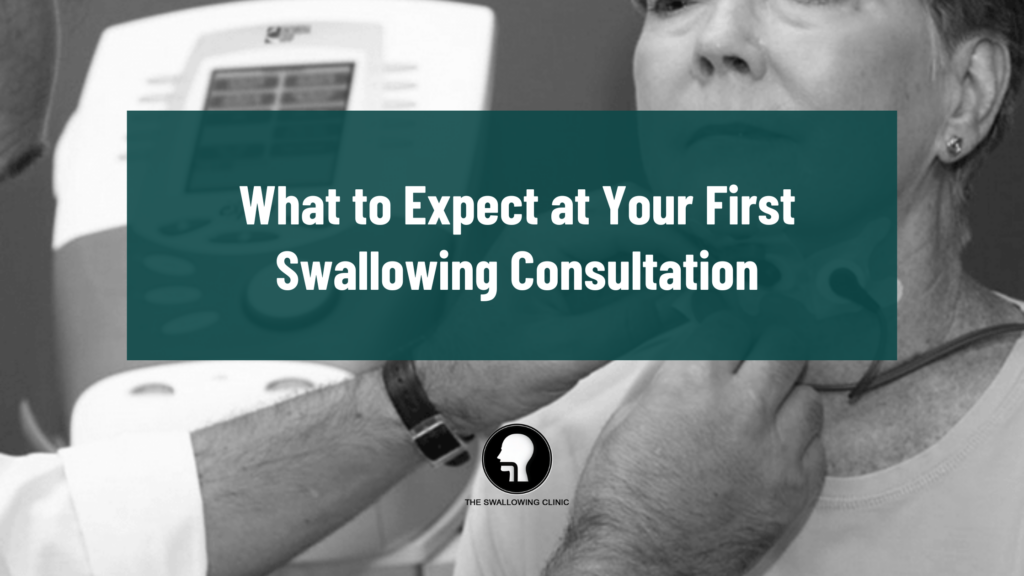
- Laryngeal elevation - they'll place a hand lightly on your throat and ask you to swallow to feel how much the larynx moves
- Voice quality, which can indicate how well the vocal folds are functioning and whether there's any residue around the larynx
You'll be asked to perform a few simple movements - stick your tongue out, move it from side to side, puff your cheeks, hold a sound. None of it is difficult or uncomfortable. The clinician is gathering information about the strength and coordination of the muscles that do the work of swallowing.
The Eating and Drinking Portion
This is the part most people are curious about. After the oral motor exam, your clinician will observe you eating and drinking various food and liquid consistencies while they watch for signs of difficulty.
What's typically included:
- Thin liquids - usually water, given in small amounts by spoon or cup
- Thickened liquids - if thin liquids show signs of difficulty, the clinician may trial a thickened consistency to see whether it's safer
- Soft or pureed food - something that requires minimal chewing, like applesauce or pudding
- Solid food - a cracker or piece of bread, to assess how you manage something that requires chewing before swallowing
The portions are small. You're not sitting down to a full meal - you're swallowing measured amounts under observation so the clinician can assess what happens. They'll watch for coughing, throat clearing, a wet or gurgly voice after swallowing, changes in breathing, signs of fatigue with repeated swallows, and how efficiently you clear each bite.
They'll also ask you how each texture feels - whether anything seems to stick, whether you feel the need to swallow more than once, whether anything causes discomfort. Your subjective experience is part of the clinical picture.
This portion of the evaluation is the closest thing to a "test," but it really isn't one. You're not being graded. The clinician is gathering information, and there's nothing you can do to perform better or worse than you actually swallow. Just eat and drink normally and describe what you notice.
If an Instrumental Study Is Recommended
Based on the clinical evaluation, your clinician may recommend an instrumental swallowing study - either a modified barium swallow (MBS) or a fiberoptic endoscopic evaluation (FEES). This isn't always necessary, but it's recommended when the clinical evaluation raises questions that can't be answered through observation alone, or when the findings will directly affect treatment decisions.
Modified Barium Swallow Study (MBS)
An MBS takes place in a radiology suite and uses fluoroscopic X-ray imaging to capture the swallow in real time. You'll swallow food and liquids coated with barium - a contrast agent that shows up on X-ray - in various textures and amounts while the imaging runs. The procedure takes roughly 20 to 30 minutes and allows the clinician to see exactly what happens during each swallow, including whether anything enters the airway, where material is getting stuck, and whether certain textures or strategies are safer than others.
Barium doesn't taste great - most people describe it as chalky - but the food and liquid textures are otherwise normal. There's no pain involved. You may be asked to try different head positions or swallowing techniques during the study to see whether they improve safety or efficiency.
Fiberoptic Endoscopic Evaluation of Swallowing (FEES)
A FEES involves passing a thin, flexible endoscope through one nostril to view the throat directly during swallowing. The scope is about the diameter of a piece of spaghetti and does not go into the esophagus - it sits just above the larynx and provides a direct view of the pharyngeal and laryngeal structures before and after each swallow.
The scope placement can feel uncomfortable - most people describe a mild pressure or tickling sensation in the nose - but it's well-tolerated and takes only a few seconds to position. A topical anesthetic spray is sometimes used to reduce discomfort. Once the scope is in place, you eat and drink normally while the clinician observes on a monitor.
If an instrumental study is recommended at your initial visit, our team will explain why it's indicated, what it involves, and what the scheduling process looks like. In some cases it can be performed the same day; in others it may require a separate appointment depending on scheduling and facility availability.
What Happens After the Evaluation
At the end of your appointment, your clinician will sit down with you and go over what the evaluation showed. You'll get a plain-language explanation of the findings - what's working well, where the difficulty is occurring, and what it means for how you eat and drink right now.
-
1You'll receive immediate recommendations
If the evaluation identifies a safety concern - for example, if thin liquids are consistently entering your airway - your clinician will give you guidance before you leave. This may include a recommended liquid consistency, a safer cup or utensil, or a swallowing technique to use at meals right away.
-
2A treatment plan will be outlined
If therapy is recommended, your clinician will explain the approach, the frequency of sessions, and what the goals are. You'll have a chance to ask questions and discuss what's realistic for your schedule and situation before committing to anything.
-
3A report goes to your referring provider
Your clinician will send a written report summarizing the evaluation findings and recommendations to your referring physician. If you're seeing other specialists, copies can be sent to them as well with your authorization.
-
4You may receive home exercises
In many cases, your clinician will give you exercises to begin practicing between now and your next appointment. These are specific to your deficit profile and are an important part of the treatment process - the work you do at home between sessions matters.
-
5Follow-up is scheduled
If ongoing therapy is recommended, you'll schedule your next appointment before you leave. Our front desk can work with your schedule to find a regular time that fits. Consistency in attendance makes a real difference in outcomes.
A word on what you might hear
Some patients leave their first evaluation with reassuring news - a mild deficit, a straightforward treatment plan, a good prognosis. Others receive information that's harder to take in - a significant aspiration risk, a recommendation to modify their diet, or findings that reflect a serious underlying condition. Either way, having an accurate picture is always better than not knowing. Your clinical team is there to help you understand the findings and figure out the best path forward from where you are right now.
Frequently Asked Questions
Still have questions about what to expect? Contact The Swallowing Clinic and we'll be happy to walk you through anything before your appointment.
Can I bring someone with me to the appointment?
Absolutely, and we encourage it. A family member or caregiver who's present at mealtimes can add useful context during the case history conversation - they often notice patterns the patient doesn't. They'll also be there to hear the findings and recommendations firsthand, which helps with follow-through at home. If you're bringing someone, just let us know when you check in.
Will the evaluation tell me definitively what's wrong?
A clinical swallowing evaluation can identify where in the swallowing process the breakdown is occurring and give a clear functional picture of the deficit. For some patients, that's a complete answer. For others - particularly when the underlying cause isn't yet diagnosed, or when the clinical findings raise questions that require imaging to answer - the evaluation is one piece of a larger diagnostic picture. Your clinician will be clear about what the evaluation can and can't tell you, and will recommend next steps if further workup is needed.
What if I don't cough or have obvious symptoms during the evaluation?
This happens fairly often, and it's not a problem. Swallowing difficulties don't always produce obvious symptoms in every situation - that's part of what makes them easy to miss. The evaluation is designed to look beyond surface symptoms at the underlying mechanics of the swallow. And if symptoms that are present at home don't appear during the evaluation, that information is useful too. Your clinician may recommend an instrumental assessment to get a clearer picture if the clinical evaluation is inconclusive.
Is there anything I should avoid eating or drinking before the appointment?
For a standard clinical swallowing evaluation, no. Eat and drink normally beforehand. If you're coming in specifically for a modified barium swallow study, call us ahead of time - there may be specific preparation instructions depending on what the study involves.
How soon will I know the results?
Your clinician will go over the findings with you at the end of your appointment. You won't leave without knowing what the evaluation showed and what the recommended next steps are. A written report summarizing the findings is typically sent to your referring provider within a few business days.
What if I'm nervous about what the evaluation might find?
That's a completely understandable feeling, and you're not alone in it. A lot of people put off getting evaluated because they're worried about what they might be told. But swallowing difficulties that go unaddressed tend to get worse, not better - and the sooner a problem is identified, the more options are typically available for treating it. Whatever the evaluation finds, knowing is always a better starting point than not knowing. We'll walk you through the results clearly and make sure you leave with a plan.